Why Is My Hair Frizzy After Washing? Causes, Solutions & the Right Haircare Routine
You step out of the shower with freshly washed hair, expecting it to look soft, smooth and beautiful. But as it dries, something completely different happens.
Your hair starts looking puffy. Flyaways appear around your head. The ends feel rough, and the smooth finish you were hoping for seems impossible to achieve.
Sound familiar?
If you've ever wondered, "Why is my hair frizzy even after washing it?", you're certainly not alone.
Frizzy hair is one of the most common haircare concerns, particularly for people with naturally wavy, curly, dry or frequently heat-styled hair.
And here's something many people don't realise: washing your hair more often or applying more conditioner doesn't necessarily solve the problem.
Sometimes, the real issue is how you're washing, drying and styling your hair.
At LOCKS ’N LURE®, we believe understanding your hair is the first step towards caring for it better.
In this guide, we'll explore why frizz happens after washing, which everyday habits make it worse and how to build a practical anti-frizz haircare routine that leaves your hair feeling softer, smoother and easier to manage.
Why Does Hair Become Frizzy After Washing?
The short answer: Hair can become frizzy after washing because of dryness, friction, existing damage, humidity, unsuitable products or the way it's dried and styled.
To understand why, it helps to know a little about your hair's structure.
Every hair strand has an outer protective layer called the cuticle. When the hair surface is relatively smooth, strands tend to reflect light more evenly and look shinier.
When strands are rough, damaged or misaligned, they can appear duller and more frizzy.
Hair also interacts with moisture in the surrounding air. Changes in humidity can affect its shape and behaviour, particularly if your hair has been styled into a pattern different from its natural texture.
This is why your hair might look smooth indoors but become puffy after spending time outside.
However, not all frizz means your hair is damaged. Sometimes it's simply part of your natural wave or curl pattern.
The goal of good haircare shouldn't be to eliminate every natural texture. It should be to improve softness, manageability and the appearance of unwanted frizz.
1. You're Using Shampoo Incorrectly
Shampoo is essential for removing excess oil, dirt, sweat and product buildup.
But shampooing the wrong way can leave your hair feeling rougher than necessary.
One common mistake is rubbing shampoo vigorously through the entire length of your hair.
Your scalp usually needs the most cleansing. Your ends, particularly if they're long, dry or colour-treated, may not need the same amount of direct shampooing.
What to Do Instead
Wet your hair thoroughly.
Apply shampoo mainly to the scalp and massage gently using your fingertips.
Avoid aggressively rubbing or twisting the lengths.
As you rinse, let the shampoo and water flow through the remaining hair.
If your hair becomes dry or frizzy easily, choose a shampoo formulated for your hair's needs.
For example, LOCKS ’N LURE Argan Shampoo is designed for dry, damaged and frizz-prone hair.
It can be part of a cleansing routine focused on maintaining softness and manageability.
If you prefer a routine focused on smoothness and shine, LOCKS ’N LURE Keratin Shampoo is another option to consider.
The important thing is choosing a shampoo your scalp tolerates well and your hair responds to comfortably.
2. You're Skipping Conditioner or Not Using Enough
If your hair feels particularly rough immediately after shampooing, your conditioning routine may need attention.
Shampoo cleanses your hair, while conditioner helps reduce friction, soften strands and improve detangling.
Skipping conditioner can leave some hair types more vulnerable to tangling, roughness and breakage.
This is especially important for long, thick, curly, colour-treated or naturally dry hair.
How to Condition Your Hair Correctly
After shampooing:
-
Gently squeeze out excess water.
-
Apply conditioner to the lengths and ends.
-
Distribute it carefully through the areas that need conditioning.
-
Leave it on for the time recommended on the product label.
-
Rinse thoroughly.
For dry and frizzy hair, LOCKS ’N LURE Argan Conditioner is formulated to help improve softness, smoothness and manageability.
Its recommended application time is 3–5 minutes.
If you have very fine hair, begin with a smaller amount focused on the ends.
If you have thick or curly hair, you may need more product to achieve even coverage.
The correct amount depends on your hair—not just the instructions you see in a social media video.
For help choosing your conditioning steps, read our hair mask vs conditioner vs leave-in guide.
3. You're Rubbing Your Hair with a Towel
This might be one of the easiest haircare habits to change.
After a shower, many people grab a towel and vigorously rub their hair to remove water as quickly as possible.
Unfortunately, rough towel drying creates unnecessary friction.
Wet hair is more vulnerable to mechanical damage, and aggressive rubbing can contribute to tangling, breakage and frizz.
A Better Way to Dry Your Hair
Instead of rubbing:
-
Gently squeeze excess water from your hair.
-
Wrap it loosely in a soft towel or cotton T-shirt.
-
Allow the fabric to absorb water without aggressive friction.
-
Detangle carefully using a suitable wide-tooth comb.
You don't need to make your hair completely dry immediately after washing.
Gentle drying can make a noticeable difference to how manageable your hair feels.
4. Your Hair Needs Additional Conditioning
Sometimes, even when you're using shampoo and conditioner correctly, your hair still feels rough.
This may happen if your hair is naturally dry, frequently heat-styled, coloured or otherwise stressed.
In these situations, an occasional conditioning treatment may help.
When Should You Use a Hair Mask?
A hair mask provides an additional conditioning step.
Depending on its formula, it may help improve softness, reduce friction and make dry hair easier to manage.
LOCKS ’N LURE Almond + Shea Butter Hair Mask is formulated for dry, frizzy and damaged-looking hair.
Its conditioning ingredients include almond oil and shea butter, and it is designed to help improve softness and smoothness.
How to Use It
After shampooing, gently squeeze excess water from your hair.
Apply the mask evenly according to its directions, concentrating on the lengths that need conditioning.
Leave it on for the recommended 3–5 minutes, then rinse thoroughly.
Depending on your hair's needs, a mask can sometimes replace your regular rinse-out conditioner on the day you use it.
You don't automatically need to use both.
Remember: A conditioning mask can improve the appearance and feel of damaged hair, but it cannot permanently repair split ends or reverse every form of structural damage.
5. You're Not Using Leave-In Conditioner
Have you ever noticed that your hair feels smooth while conditioner is on it, but becomes frizzy again after rinsing and drying?
For some hair types, regular rinse-out conditioner alone may not provide enough manageability between washes.
That's where leave-in conditioner becomes useful.
Unlike a regular conditioner, a leave-in formula remains on the hair after washing.
It can help maintain softness, make detangling easier and reduce the appearance of flyaways.
How Leave-In Conditioner Can Help Frizzy Hair
A suitable leave-in conditioner can:
-
Improve the feel of dry lengths.
-
Make hair easier to detangle.
-
Help reduce visible frizz.
-
Improve softness and manageability.
-
Support smoother-looking hairstyles.
LOCKS ’N LURE Nourishing Leave-In Conditioner features Coconut Oil, Shea Butter and Vitamin E, alongside other conditioning ingredients.
It is designed for use on dry or damp hair without rinsing.
How to Apply It
Shake the bottle well.
Spray a small amount through your hair, particularly the mid-lengths and ends.
Gently distribute the product and detangle where necessary.
Leave it in and style as desired.
For finer hair, start with less product to avoid weighing it down.
For thicker, drier or curly hair, you may need additional coverage.
6. Humidity Is Making Your Hair Frizzy
You might notice your hairstyle behaves differently depending on the weather.
Perhaps your hair looks smooth after a blowout, but becomes puffy when you step outside.
Humidity can be one reason.
Hair fibres absorb and release moisture from the surrounding environment, and this can influence their shape and mechanical behaviour.
If your hair has been straightened or styled away from its natural texture, changing humidity can affect how well that style holds.
Haircare During Humid Weather in Pakistan
In places such as Lahore, Karachi and Islamabad, weather conditions vary by season.
On humid days, you may find that your hair needs different styling techniques than it does in drier conditions.
Try these adjustments:
-
Keep your hair adequately conditioned.
-
Use leave-in products in amounts appropriate for your texture.
-
Avoid unnecessary manipulation once hair is dry.
-
Choose hairstyles that work with your natural texture.
-
Avoid excessive product layering that leaves hair heavy or sticky.
If you have naturally curly or wavy hair, consider embracing your natural pattern rather than repeatedly straightening it.
7. Your Heat Styling Routine May Be Contributing to Frizz
Straighteners, curling irons and blow dryers can help create polished hairstyles.
But excessive heat can also contribute to dryness, breakage and roughness.
If you're already dealing with frizz, repeatedly applying high temperatures may make the problem worse over time.
The solution isn't necessarily giving up heat styling.
It's using heat more carefully.
Protect Your Hair Before Styling
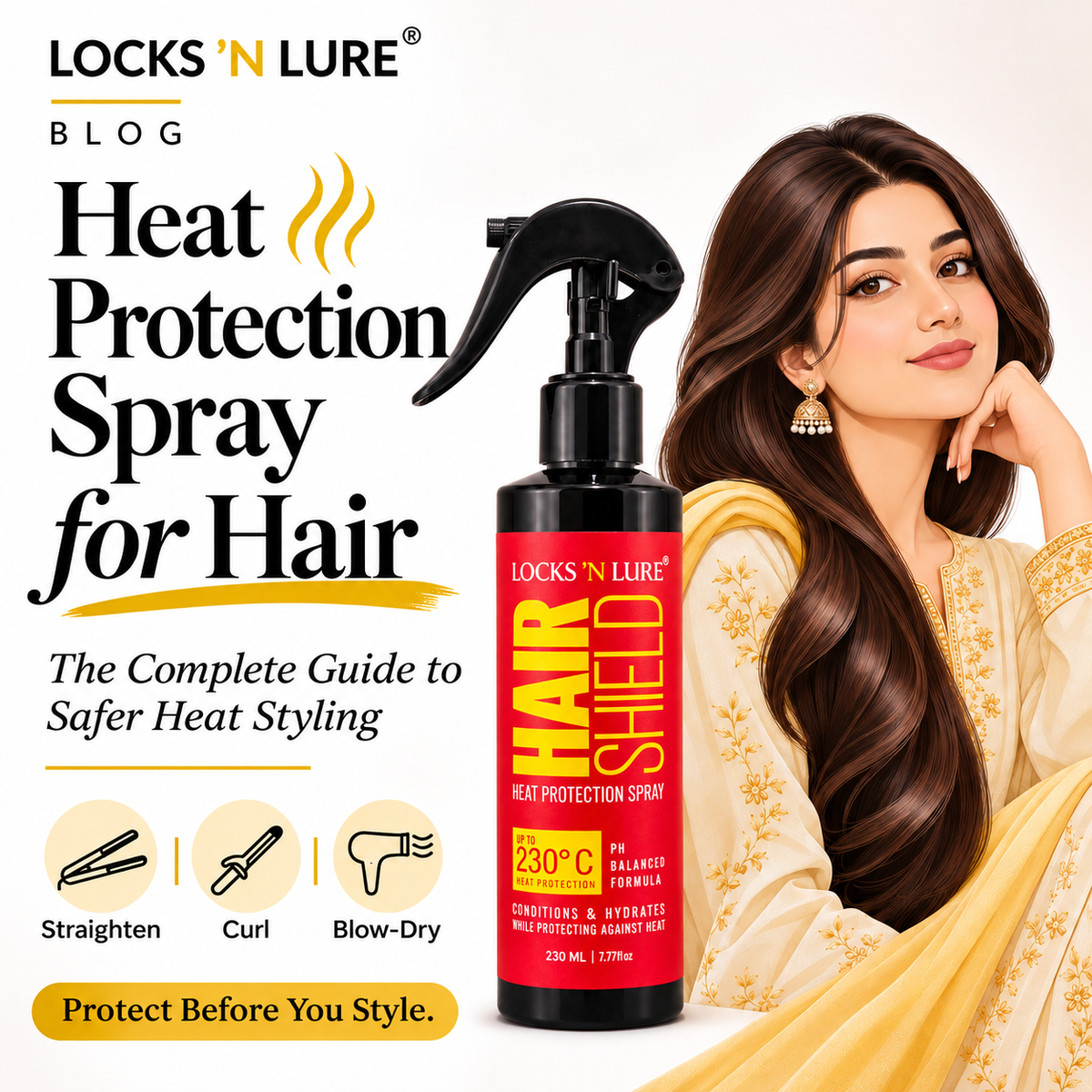
When using heated tools, consider a dedicated thermal protectant such as LOCKS ’N LURE Hair Shield Heat Protection Spray.
Hair Shield is marketed with heat protection up to 230°C and is designed to help improve manageability during styling.
However, that maximum protection claim doesn't mean you should style at 230°C.
Use the lowest effective temperature for your hair.
For conventional straighteners and curling irons, make sure your hair is completely dry before applying direct heat.
Even with a heat protectant, repeated high-temperature styling can still cause damage.
For application steps and tool-specific tips, explore our heat protection spray and safer styling guide.
8. You May Be Brushing Your Hair at the Wrong Time
Not all hair types should be handled in exactly the same way.
If you have naturally curly hair, repeatedly brushing it when dry can separate curl clumps and create a fluffy appearance.
For straight hair, aggressive brushing while soaking wet can also contribute to breakage.
Better Detangling for Different Hair Types
Straight hair: Allow it to dry slightly before gently detangling with a suitable comb.
Wavy hair: Detangle carefully while conditioned, then avoid excessive brushing once the waves begin forming.
Curly hair: Detangle while the hair is damp and conditioned, using your fingers or a wide-tooth comb.
Coily hair: Work gently in sections, with adequate conditioning to reduce unnecessary pulling.
Start from the ends and gradually move upward.
A good detangling technique can reduce breakage and make your hair easier to style.
9. Is Your Hair Really Frizzy, or Is It Naturally Wavy?
Here's an interesting possibility.
Sometimes hair that appears frizzy after washing is actually naturally wavy or curly hair that hasn't been styled in a way that supports its texture.
For example, if your hair forms loose bends when wet but becomes puffy after brushing, you may have a natural wave pattern.
Instead of trying to force it completely straight, experiment with a styling routine that encourages the waves to form.
Try This Simple Wavy-Hair Routine
After shampooing and conditioning:
-
Gently remove excess water.
-
Apply a suitable leave-in conditioner if needed.
-
Distribute a small amount of curl styling product.
-
Scrunch the hair upward.
-
Allow it to air-dry or use a diffuser at an appropriate setting.
-
Avoid repeatedly touching the hair while drying.
LOCKS ’N LURE Curl Romance Curl Lotion is designed to help define natural curls and waves while improving softness and manageability.
Not every type of frizz is solved by straightening. Sometimes supporting your natural texture produces a more comfortable result.
10. How to Identify the Cause of Your Frizz
Before buying another product, consider when the frizz appears.
| What you notice | Possible reason | What to try first |
|---|---|---|
| Hair feels rough immediately after shampoo | Insufficient conditioning or unsuitable cleansing routine | Focus shampoo on the scalp and use conditioner |
| Hair becomes puffy while towel drying | Excess friction | Use a soft towel or T-shirt and gently blot |
| Hair looks smooth while wet but frizzes as it dries | Natural texture, dryness or styling technique | Try leave-in care and gentler drying |
| Frizz increases outdoors | Humidity and hair's response to moisture | Adapt styling and avoid overhandling |
| Ends look rough and split | Existing damage or breakage | Reduce heat, condition and trim split ends as needed |
| Hair feels heavy but still looks frizzy | Product buildup or over-layering | Simplify the routine and cleanse as needed |
| Hair becomes fluffy after brushing | Separation of natural waves or curls | Detangle at a more suitable stage |
These are clues rather than definitive diagnoses. More than one cause may be contributing to your hair's behaviour.
11. The LOCKS ’N LURE Anti-Frizz Haircare Routine
You don't need ten different hair products to begin improving your routine.
The aim is to choose a few products that work well together.
Here's a practical example.
Step 1 — Cleanse
Use a suitable shampoo such as LOCKS ’N LURE Argan Shampoo or Keratin Shampoo.
Massage the scalp gently and rinse thoroughly.
Step 2 — Condition
Use Argan Conditioner or another rinse-out conditioner suited to your hair.
Concentrate on the lengths that need conditioning.
Step 3 — Add a Hair Mask When Needed
On selected wash days, consider Almond + Shea Butter Hair Mask as an additional conditioning treatment.
It may replace regular conditioner, depending on your hair and the formula.
Step 4 — Dry Gently
Avoid rubbing your hair vigorously.
Use a soft towel or cotton T-shirt to absorb excess moisture.
Step 5 — Apply Leave-In Conditioner
If your hair feels dry or tangles easily, use a small amount of Nourishing Leave-In Conditioner.
Step 6 — Style According to Your Hair Type
For natural waves and curls, consider Curl Romance Lotion.
For blow-drying, straightening or curling with heat, use Hair Shield Heat Protection Spray and follow safe styling practices.
Step 7 — Avoid Excessive Product Layering
If your hair already feels soft and manageable, you may not need extra serum, oil or styling products.
Start simple and adjust.
The ideal anti-frizz routine isn't the one with the most products. It's the one that leaves your hair comfortable, manageable and suited to your natural texture.
12. The Right Anti-Frizz Routine for Different Hair Types
Fine or Straight Hair
Fine hair can easily become weighed down.
A useful starting routine is:
-
Suitable shampoo.
-
Lightweight application of conditioner on the ends.
-
Small amount of leave-in conditioner only if needed.
Avoid unnecessarily heavy masks, oils and multiple finishing products.
Thick, Dry or Frizz-Prone Hair
Thicker hair may benefit from more intensive conditioning.
Consider:
-
Argan Shampoo.
-
Argan Conditioner.
-
An occasional Almond + Shea Butter Hair Mask.
-
Leave-In Conditioner for additional manageability.
Focus on gentle detangling and reduced styling friction.
Curly or Wavy Hair
For naturally curly or wavy hair:
-
Cleanse according to your scalp's needs.
-
Use a conditioner that makes detangling easier.
-
Apply leave-in conditioner if needed.
-
Use Curl Romance Lotion for curl definition.
-
Allow hair to dry without excessive brushing or touching.
Colour-Treated or Heat-Styled Hair
Hair affected by colouring or frequent heat styling may require additional care.
Use suitable conditioning products and reduce unnecessary high-temperature styling.
Consider Hair Shield before heated styling, but remember that no protectant can eliminate every risk of damage.
13. Five Common Anti-Frizz Myths
Myth 1: Washing Your Hair Every Day Will Make It Smoother
Not necessarily.
Hair-washing frequency should depend on your scalp's oiliness, hair texture, lifestyle and product buildup.
Some people need frequent washing; others do better with less frequent cleansing.
Myth 2: More Hair Oil Always Means Less Frizz
A little suitable oil or serum may improve the appearance of dry ends.
Too much can leave hair greasy, coated or weighed down without addressing the underlying issue.
Myth 3: A Sulfate-Free Shampoo Automatically Prevents Frizz
Not necessarily.
A shampoo's overall formulation and how it suits your hair matter more than a single ingredient category.
Myth 4: Heat Protection Means Heat Cannot Damage Hair
Incorrect.
Heat protectants can help reduce certain forms of damage, but they cannot make hair completely heatproof.
Myth 5: Frizzy Hair Is Always Unhealthy Hair
Not true.
Some frizz is simply part of natural curls, waves or new hair growth.
Not every flyaway is evidence of damage.
14. Try a Simple Anti-Frizz Routine Over Your Next Two Washes
Before replacing every product on your shelf, try making a few consistent changes.
On your first wash:
-
Shampoo gently, focusing on the scalp.
-
Condition the lengths thoroughly.
-
Avoid rough towel drying.
-
Use a small amount of leave-in conditioner if needed.
-
Allow hair to dry with minimal handling.
Observe how your hair behaves.
On your second wash:
Keep the same cleansing and conditioning routine.
If your hair still feels rough, consider using a suitable conditioning mask according to its label directions.
If your hair forms natural waves or curls, try styling those patterns rather than brushing them out.
Compare the results.
This won't reverse structural hair damage in two washes, but it may help you identify which habits improve the appearance and manageability of your hair.
15. Frequently Asked Questions About Frizzy Hair
Why is my hair frizzy even after using conditioner?
Your conditioner may not provide the type or amount of conditioning your hair needs. Frizz may also be related to towel drying, heat exposure, humidity or existing damage.
Try adjusting your drying technique and consider a suitable leave-in conditioner.
Should I apply hair oil to wet or dry hair?
This depends on the oil and its directions. Some products are intended for pre-wash care, while others are used sparingly on lengths or ends.
Avoid assuming any ordinary oil can replace a heat protectant.
Can leave-in conditioner help with frizz?
Yes. A suitable leave-in conditioner can improve softness, detangling and the appearance of flyaways.
Use an amount appropriate for your hair thickness.
Is a hair mask or conditioner better for frizz?
Conditioner is generally a routine wash-day step. A mask may provide extra conditioning when hair feels particularly dry or rough.
Neither is automatically better for every person.
Does cold water prevent frizzy hair?
There's no good reason to expect a cold-water rinse alone to solve frizz.
Comfortable water temperatures, appropriate conditioning and gentle drying are more useful starting points.
Why is my hair smooth when wet but frizzy when dry?
As hair dries, its natural shape becomes more visible. Friction, moisture changes and the way you handle your hair can also affect the finished appearance.
Can humidity cause frizz after washing?
Yes. Hair interacts with moisture in the surrounding air, which can affect its shape and styling behaviour.
This may be particularly noticeable in naturally wavy or curly hair.
How do I stop my hair from becoming frizzy overnight?
Try reducing friction while sleeping, avoiding tight hairstyles and keeping your hair conditioned appropriately.
A smooth pillowcase or loose protective hairstyle may help some people.
Is keratin shampoo good for frizzy hair?
A suitable keratin-containing shampoo can be part of a routine focused on smoothness and manageability.
However, the results depend on the complete formulation and your hair's needs. It will not permanently change your natural hair texture.
Should I use serum after leave-in conditioner?
You can, if your hair needs additional smoothness or shine and the products are compatible.
Start with small amounts and avoid excessive layering.
Why is my scalp oily but my hair ends dry and frizzy?
Your scalp and hair lengths have different needs.
You may need effective scalp cleansing while concentrating conditioning products on the mid-lengths and ends.
Can frizzy hair become completely smooth?
Conditioning and styling can improve smoothness and reduce unwanted frizz, but the results depend on your natural hair texture, condition, humidity and routine.
Perfectly smooth hair at all times isn't a realistic expectation for everyone.
When Should You Seek Professional Advice?
Frizz alone is usually a cosmetic concern, but seek advice from a dermatologist if you're also experiencing persistent scalp irritation, sudden shedding, patchy hair loss or significant unexplained breakage.
A change in hair products cannot treat every underlying scalp or hair condition.
Final Thoughts: Beautiful Hair Begins with Understanding It
Frizzy hair can be frustrating, especially when you've just washed it and expected a smooth, polished result.
But you don't need to fight your natural texture or constantly replace your haircare products.
Start with the basics.
Choose a shampoo that suits your scalp. Condition your hair appropriately. Avoid rough towel drying. Be gentle when detangling. Protect your hair from unnecessary heat and use styling products that support your hair type.
Most importantly, pay attention to what actually works for you.
Sometimes, a small change in how you wash or dry your hair can be more valuable than adding another complicated step.
At LOCKS ’N LURE®, we're here to help make everyday haircare easier, more practical and more enjoyable.
Discover Haircare Products for Frizzy Hair
Explore our range of shampoos, conditioners, masks and styling essentials designed to support softness, smoothness and manageability.
Find the products that suit your routine in the LOCKS ’N LURE Hair Conditioning Collection.